

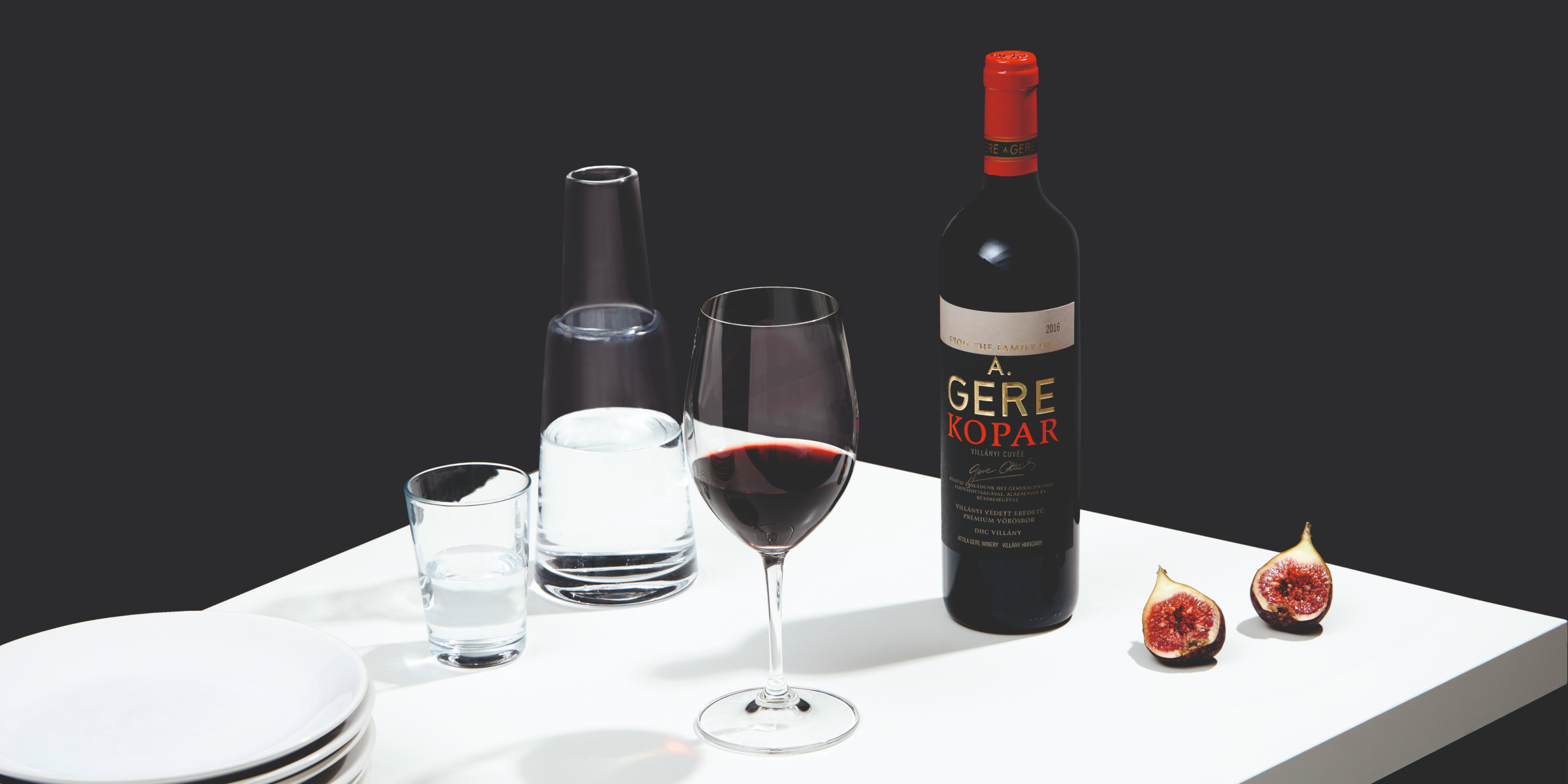
For most wine lovers, Kopar is synonymous with our winery and it is no coincidence that we consider it our flagship wine. Its history and refined style demonstrate how we have evolved while staying true to our values.
The story of Kopar began with the 1997 vintage, but it was already part of a development process that had begun earlier. In the first half of the 1990s, an increasing number of Villány winemakers began to focus more closely on the grape varieties with which France’s Bordeaux wine region had achieved international success—varieties that had already been present in the Villány wine region. Cabernet Sauvignon, Franc, and Merlot came into the spotlight. Consequently, a group of Villány winemakers, including our winery’s founder Attila Gere, travelled to the French wine region. They returned home deeply inspired and with a wealth of experience. Visiting several major châteaux and tasting their wines left a lasting impression on them.
Inspired by the experiences gained here, we created a cuvée of Cabernet Sauvignon, Cabernet Franc, and Merlot, which we have blended from the finest grapes of the winery’s best vineyards since its very first vintage in 1997, and named after the highest-rated vineyard in Villány. This was a pioneering move in itself, as it was not yet common in Hungary in the 1990s to give a wine a fanciful name.
Another first for the country was our creation of a pre-order system in collaboration with one of Hungary’s leading wine merchants, Bortársaság, based on the Bordeaux en primeur system – though implemented differently. Under this system, Kopar wines that have already been bottled but will not be released to the market for another six months can be purchased in advance in cases of 12 bottles. The fact that Kopar pre-orders have remained a significant event in the Hungarian wine market for decades proves that the wine is still highly relevant and valuable.
As with all our premium wines, we apply strict yield control at Kopar, leaving only the five or six finest clusters on each vine. However, this is by no means the end of the grape selection process. At harvest time, the grapes undergo manual and mechanical sorting to ensure that only the most beautiful, high-quality grapes are processed. While this may seem excessive, given the rigor of the vineyard work, we prefer to err on the side of caution.
Like us, Kopar has its own development history. Initially, Cabernet Sauvignon and Merlot dominated, as is the case with most Bordeaux blends around the world. However, the more we tasted, the more experience we gained, the more we came to understand the characteristics of our wine region and the more we discovered the unique wines that Villány produces from the Cabernet Franc grape variety. This led to a transformation of Kopar. 2006 was a watershed vintage, after which we began building Kopar on a Cabernet Franc base. In parallel, the proportion of Cabernet Sauvignon decreased and the barrel ageing process became more subtle.
All three grape varieties used in the wine are aged separately in individual barrels, with vineyards and plots treated individually, for approximately 16–18 months. This is followed by a lengthy two-month blending process. First, we taste the contents of every barrel that have the potential to contribute to our great wines. Then, we analyse the trial blends. This work requires intense concentration, as one must be sensitive to even the slightest nuances in this category, where the wines are destined to age and evolve for decades.
A few years ago, when we were in London, we visited the wine shop that distributes A.GERE wines. They told us that Madonna was performing in the city and that her manager had bought a bottle of Kopar from them. We don’t know if she actually received it or tasted it, but maybe we’ll have a chance to ask her someday.
However, the wine certainly reached important experts in international professional circles. James Suckling served as editor of Wine Spectator magazine for decades, from 1981 onwards. In 2005, a friend invited him to dinner at the famous and notoriously expensive Campanile restaurant. The condition for joining the dinner was that everyone bring a bottle of wine to be tasted blind with the meal, and whoever brought the two worst bottles would pay the bill. Understandably, no one wanted to lose, so the guests arrived with one exceptional bottle after another.
In the end, to everyone’s astonishment, one of the two wines at the end of the line was a 1989 Château Pétrus that had previously been rated 100 points, which the owner had purchased at auction for $1,300. According to Suckling, the big bombshell of the evening was our 2000 Kopar: „The big surprise of the evening, however, was No. 10. It was a 2000 Gere Attila Kopar, a Bordeaux-style blend from Hungary. I had never heard of it, much less tasted it. When a Hungarian red beats Pétrus in a blind tasting, you know the world of wine is a gunslinger’s paradise.”


